
.svg)
.jpeg)
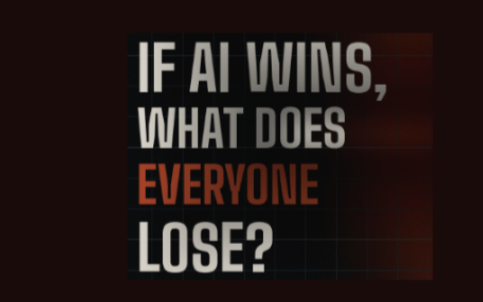

I talk to a lot of people about AI and what it will look like in the not-so-distant future. I’ve realized the conversation around AI tends to split into two camps: utopian and catastrophic. Both miss the quieter, more likely outcome. A world where AI doesn't destroy us or save us, but slowly narrows what we're expected to do, think, and become.
That narrowing is already underway. It shows up in junior employees who never learn to write because a tool does it for them. The researcher who stops reading deeply because a summary is faster. In the voter who can no longer tell a real video from a fake one. It's the steadily increasing number of tools and platforms that are beginning to eliminate the need for the BDR/SDR role in enterprise sales processes. Not to mention the almost daily news stories about massive layoffs as companies replace humans with AI. These aren't just use cases. They're early signals of a broader shift: a gradual offloading of human judgment to systems optimized for speed and scale, not wisdom or accountability. The risks aren't theoretical. They're quietly accumulating in the daily decisions we've stopped noticing, and it’s just become part of the “next phase” of life.
We're building systems faster than we're asking what they cost us. Not in dollars. In agency, identity, and the kind of work that makes us feel human.
Here are five ways we may lose if AI wins:
- We lose the struggle that sharpens us. We’ve all heard the old adage, “Iron sharpens iron”, but what happens when we remove the iron that sharpens through best practices and human interaction or conversations? At that point, difficulty is a feature, not a bug. When AI handles the hard parts, we get the answer without the growth. Competence is built through friction, and we're quietly removing it.
- We lose economic diversity at the bottom. AI doesn't just automate tasks. It concentrates power. The people who build and own these systems gain leverage; everyone else negotiates from a weaker position. It becomes even more obvious and scary when that concentration remains at the top and never trickles down.
- We lose trust in what we read, see, and hear. When content is cheap to fabricate and hard to verify, skepticism becomes the default. That's not just a media problem. It's a social one, too. Maintaining shared reality is harder than it looks. As we’re seeing in our American political space, erosion of trust is the first step toward division and the loss of freedom.
- We lose the questions we never think to ask. AI is very good at giving us what we ask for. It's less good at helping us notice what we're not asking. That blind spot, over time, shapes what we believe is possible. Sure, we can always get content from AI, but we still need humans to provide the context. Without that, things get really scary.
- We are losing access to clean, affordable water. Training and running large AI models require enormous data centers, and those data centers are thirsty. A single large AI query can consume several gallons of water for cooling. Globally, the industry's water footprint is growing rapidly, often in regions already under stress. Communities near major data centers are already seeing strain on local water tables. Especially in underserved communities. This is not a future concern. It is a present one, and it disproportionately affects the people least likely to benefit from the technology consuming it.
None of this is inevitable, but it won't resolve itself, either. The companies building these systems and the people using them need to keep the harder question in mind: not just what AI can do, but what we want to preserve when it does. If you believe that if AI wins, we all lose, what can we, as humans, do to combat it, or is it already too late?
If you believe the costs of AI deserve as much attention as its capabilities, share this piece with someone who needs to read it. If you're building, funding, or regulating these systems, ask harder questions before the next deployment, not after.
When you are ready, here are a few ways we can continue your journey together.
- Subscribe to THIS newsletter and make sure you have LinkedIn newsletter notifications turned ON!
- If you’d like to stay connected on social media, follow us on LinkedIn | YouTube | Instagram | Facebook, and make sure you hit the subscribe button!
- Click here to schedule a complimentary meeting.
.png)


