
.svg)
.jpeg)
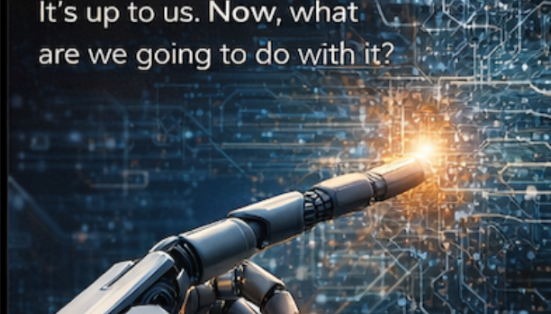

We’ve been lied to about Artificial Intelligence (AI). On one hand, we’re offered apocalyptic prophecies of job loss and oppression, even human extinction. On the other hand, we hear utopian fantasies of a future without toil or sickness, perhaps even without death, a life without meaning or mission.
There's a conversation we need to have about artificial intelligence, and it starts with a reality check:
AI is a tool. That's it.
I know that sounds underwhelming in an era of constant headlines about machines that will either save or destroy humanity. But strip away the hype and the dread, and what you're left with is something far more mundane and far more important. AI is software. It's a capability we can harness, much as we harnessed word processors, spreadsheets, and presentation software.
The outcomes we get from AI are only as good as the inputs we provide. Ask a vague question, and you get a vague answer. Provide thoughtful context and clear direction, and you might be surprised by what's possible. This isn't magic. It's the same principle that governs every tool humans have ever created: garbage in, garbage out.
The Divinity Delusion
Somewhere along the way, we started talking about AI as if it had agency. As if it made choices. As if it woke up one morning and decided to eliminate jobs, write poetry, or invade our privacy. It does none of these things.
AI cannot snap its fingers and eliminate jobs. People use AI to cut jobs or create them. The technology itself is neutral regarding employment. What matters is how organizations deploy it and whether we, as a society, build systems that ensure displaced workers have pathways to new opportunities.
AI cannot decide to oppress us. People build AI tools that either protect privacy and civil liberties or erode them. The algorithms don't write themselves, and the data collection practices don't emerge from thin air. Every surveillance system, every biased model, and every privacy violation is the result of human choices by human designers working for human-led organizations.
AI did not choose to write poems, generate images, or produce the flood of synthetic content we see online. People chose to build these capabilities.
More to the point, people chose to build cheap consumer novelties rather than invest heavily in genuine productivity tools that could transform how we work, learn, or solve complex problems.
The Responsibility We Can't Outsource
This matters because treating AI as an independent actor lets us off the hook. We create a convenient scapegoat for decisions that are fundamentally human.
Job cuts? Blame AI. Privacy erosion? The algorithm did it. A marketplace flooded with generated content rather than tools that amplify human capability. That's exactly what AI does. None of this is true. These are choices about what to build, how to deploy it, and who benefits from the deployment.
The executive who uses AI to justify layoffs while protecting their own compensation package is making a choice. The product team that prioritizes viral AI features over privacy safeguards is making a choice. The venture capitalists who fund companies building disposable AI toys rather than meaningful productivity tools are making choices.
What This Means for the Road Ahead
If we want AI to be a force for good, to enhance human capabilities rather than replace human workers, and to protect civil liberties rather than erode them, we need to stop pretending the technology will resolve these issues on its own.
We need to make better choices. We need to demand better from those who build these systems. We need regulation that reflects values, not just market forces. We need to invest in tools that make people more productive, not merely more entertained. And we need to remember every day that AI is just a tool.
The world it creates will reflect the world we choose to build with it.
Best Practices for Responsible AI Use
- Be specific with your prompts. Treat AI like you would a skilled colleague who needs clear direction. The more context and detail you provide, the better the output you'll receive. Vague requests yield vague results.
- Verify the output before acting on it. AI can be wrong, outdated, or biased. Always review its output and cross-check important information. Your judgment remains the final quality control.
- Use AI to augment, not replace, human expertise. The best results come when AI handles routine tasks while humans focus on strategy, creativity, and decision-making. Let the tool do what tools do best and keep the thinking where it belongs.
- Consider the ethical implications of deployment. Before implementing AI in your organization, ask who benefits, who might be harmed, and whether you're building something that aligns with your values. Technology is never neutral in practice.
As I said at the beginning of this newsletter, AI is a tool. That's it. The power has always been ours. The responsibility has always been ours. It's time we started acting like it!
When you are ready, here are a few ways we can continue your journey together.
- Subscribe to THIS newsletter and make sure you have LinkedIn newsletter notifications turned ON!
- If you’d like to stay connected on social media, follow us on LinkedIn | YouTube | Instagram | Facebook, and make sure you hit the subscribe button!
- Click here to schedule a complimentary meeting.
.png)


